THE PROGRAMME READ · Programme readiness
TSB Spent £330 Million Fixing a Programme That Was Declared Ready to Go Live
By Anita Appiah ·

Republished from Anita’s original LinkedIn edition. The article retains its original wording and publication context. The current Programme Health Audit takes 10–15 minutes.
The board had approved the go-live, and the programme had been reviewed.
I mean, there were testing processes, readiness assessments, and written assurances around the migration.
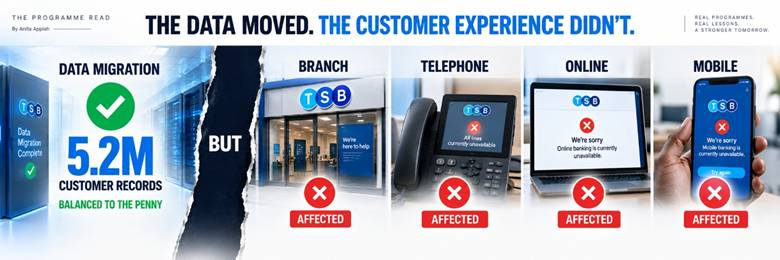
Then TSB moved 5.2 million customer records onto its new banking platform over the weekend of 20 to 22 April 2018.
The data migration itself went smoothly.
But what happened next did not.
The platform immediately experienced technical failures.
Customers struggled to access their accounts.
Branch, telephone, online, and mobile banking services were all affected.
Some customers continued experiencing problems for months.
And guess what?
TSB did not return to business-as-usual until December 2018.
CEO Paul Pester resigned in September.
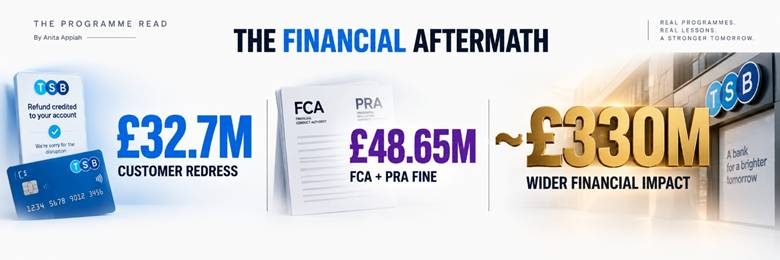
Four years later, the FCA and PRA fined TSB £48.65 million for failures relating to operational risk management and governance.
TSB ultimately put the wider cost of the crisis at around £330 million.
But the number that interests me most is not £330 million.
It is this:
The programme had reached go-live, and the reporting system had produced enough assurance for the board to approve go-live.
But the programme was not ready.
That is the part of this story I want to talk about.
The Programme Had the Machinery of Oversight
This was not a migration somebody put together over a weekend.
Development and testing of the new platform had been underway for years.
There were plans, testing processes, governance structures, readiness assessments, and written attestations around the effectiveness of testing.
And ultimately, there was board approval to migrate.
In evidence given after the failure, TSB's then CEO Paul Pester said those written assurances had been instrumental in enabling the board to make the decision to migrate in good faith.
Yet when the regulators completed their investigation, their conclusion was stark.
TSB had failed to organise and control the migration programme adequately.
They said the governance of the programme had been insufficiently robust.
That distinction matters.
Because having governance around a programme and having governance capable of exposing whether that programme is truly ready are not necessarily the same thing.
And that, my people, is the problem.
What Actually Happened in April 2018
TSB was moving away from the Lloyds Banking Group infrastructure it had been using and onto a new platform following its acquisition by Banco Sabadell.
It was an enormous undertaking.
Over the migration weekend, TSB extracted and moved the records of 5.2 million customers.
According to evidence subsequently given to Parliament, that represented around 1.3 billion records.
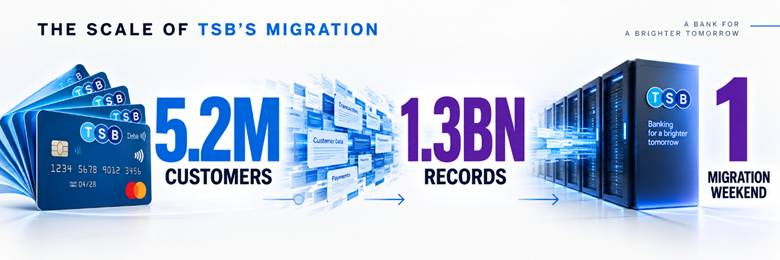
The data itself migrated successfully, and the bank balanced to the penny.
But once customers began using the new platform, serious technical problems emerged.
Branch, telephone, online, and mobile banking services were all affected.
And some customers continued experiencing problems long after the initial migration weekend.
It took until December 2018 for TSB to return to business-as-usual.
The regulatory consequences followed.
The FCA and PRA eventually imposed a combined fine of £48.65 million.
TSB also paid £32.7 million in customer redress, and the wider financial impact of the crisis reached around £330 million.
This was not simply a difficult launch.
It actually became a business crisis.
The Technology Failed. So Did the Governance Around It.
Now, this is where I think the TSB story becomes more useful than another post-mortem about an IT failure.
Because yes, there were technical failures and the regulators were explicit about that.
But they were equally explicit about something else.
The programme had not been organised and controlled adequately.
Its governance was not robust enough, and its operational risks had not been managed adequately.
That matters because the question is no longer simply:
Why did the technology fail?
There is another question:
Why did the organisation believe it was ready to go live?
Those are two different questions.
And after more than twenty years working around complex programmes, the second question interests me just as much as the first.
To my mind, one of the most dangerous assumptions an executive can make is that because information has passed through the proper reporting structure, the picture arriving at the top must therefore represent the whole reality underneath.
Sometimes it does.
Sometimes it does not.
I cannot tell you every conversation that happened inside TSB before that migration.
The regulatory findings cannot tell us that either.
But I can tell you what the gap between formal reporting and delivery reality looks like because I have seen versions of it repeatedly.
In practice, a serious issue often arrives in the formal report as something being monitored.
Decisions that have been waiting for weeks sit in action logs that nobody discusses.
Everybody involved can defend the piece of information they supplied.
But when those pieces finally reach the person accountable for the outcome, the complete picture can look very different from what the people closest to delivery are experiencing.
That is not necessarily dishonesty.
And I am less interested in finding a villain than I am in understanding the structure that allowed the gap to exist.
Because if the structure remains unchanged, replacing the people does not necessarily fix the problem.
I See Versions of This in Programmes Far Smaller Than TSB
You might be reading this thinking TSB was an exceptional case.
A banking migration of that scale, complexity, and ambition?
Maybe so.
But the failure pattern is not exceptional at all.
Let me tell you what I see in programmes far smaller than TSB.
A CEO sits in a programme review meeting.
The health ratings show two amber items and one red.
The person running delivery explains each one.
Most times, the explanations are reasonable.
The CEO leaves thinking, “This seems manageable. The programme is under control.”
Three months later, the deadline slips by six months.
Then comes the phone call.
"Anita, where did that come from?"
And sometimes I have to say, “It was visible in February, in the conversations after the meeting, in what people were saying to each other when the formal update was over. It was in the corridor. It just did not make it into the room.”
Right?
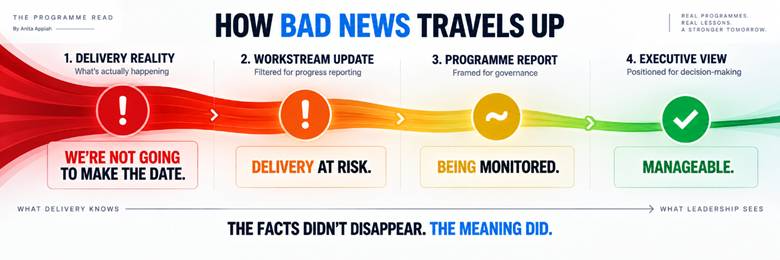
That is the gap executives need to worry about:
Whether the structure producing their reports is capable of surfacing the information people would rather not put on the page.
Whether somebody can say, "We are not going to make this date," and have that travel unchanged to the person who needs to hear it.
Whether a risk can remain red when the people in the room want it amber.
Whether an uncomfortable issue can survive the journey from the person who sees it to the person with the authority to act on it.
I have sat in meetings where the programme looked healthy in the room and the conversation outside told a completely different story.
That gap is where trouble compounds, not because everybody involved is failing at their job or because someone has necessarily lied.
The structure was simply never built to carry the full weight of the truth once that truth became uncomfortable.
One Question Before Your Next Board Meeting
If something significant were going wrong inside your programme right now, what is the route by which it would reach you?
Think about that for a moment.
Can you name the route?
Can you trace it?
And can you prove that it works when the information travelling through it is something nobody wants to hear?
That is a very different test from asking whether you receive a weekly programme report.
TSB had reporting, oversight, assurance, and a board decision.
Yet regulators ultimately concluded that the governance surrounding the migration programme had not been robust enough.
I call this Transformation Theatre, and that is why I built the Programme Health Audit.
It contains 24 questions across six dimensions designed to test whether the governance around a programme is actually doing what leadership assumes it is doing.
Dimension 1 examines whether the information reaching the executive accountable for the programme reflects what is actually happening.
Dimension 2 examines whether the governance around the programme produces real decisions and accountability rather than simply the appearance of oversight.
The full audit takes about 20 minutes.
It is free.
You can find it in my Featured section here on LinkedIn.
And if your score comes back below 48 out of 96, that is the point at which I would stop asking whether you simply have a delivery problem and start looking at the governance around it.
If you want to talk through what your score means, you can also book a 20-minute Programme Review with me.
And if this is the kind of programme conversation you want more of, subscribe to The Programme Read.
Because sometimes the biggest programme risk is not the problem nobody knows about.
It is the problem everybody can see except the person who needs to act.
Dr. Anita Appiah
Programme Health Specialist
Founder, PAGL