THE PROGRAMME READ · Business transformation
MTN Ghana Took Seven Years to Separate MoMo From Its Telecoms Business. That Is Not a Story About Delay.
By Anita Appiah ·
Republished from Anita’s original LinkedIn edition. The article retains its original wording and publication context. The current Programme Health Audit takes 10–15 minutes.
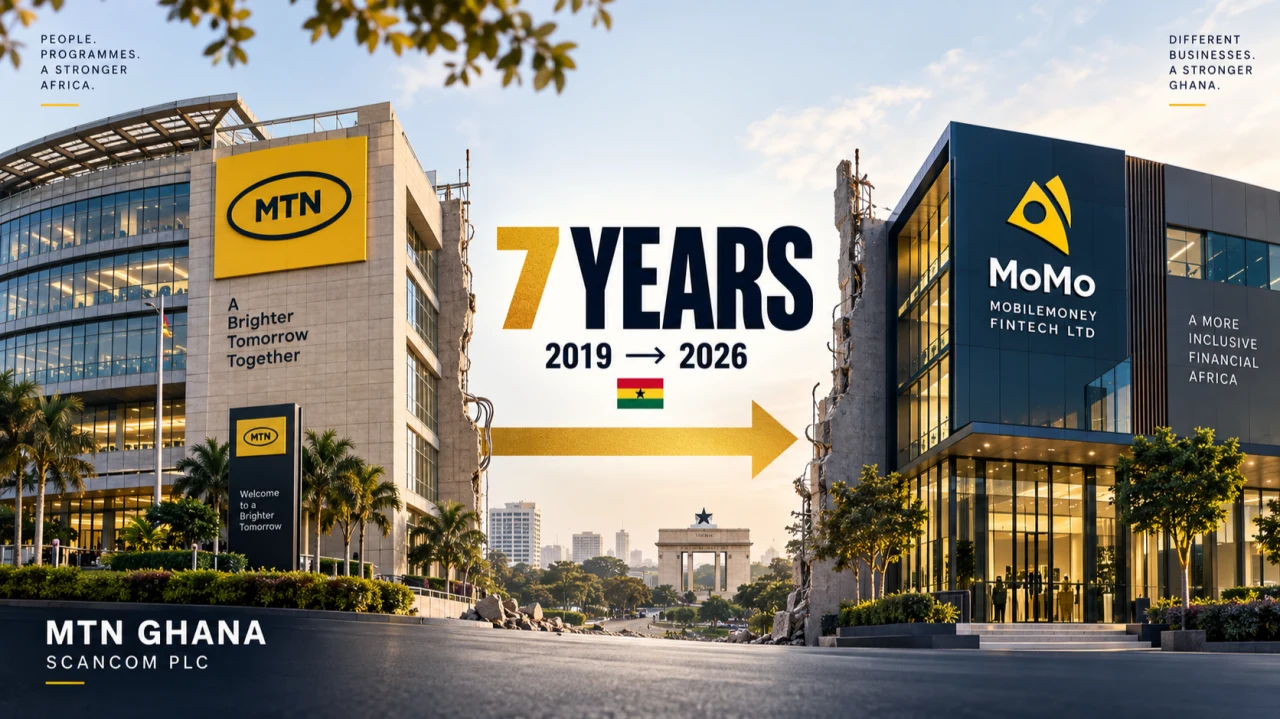
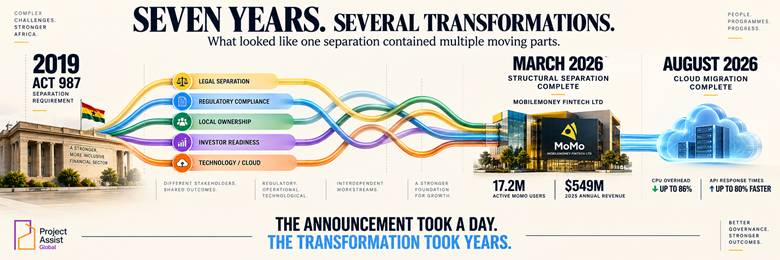
In March 2026, MTN Ghana completed the structural separation of its mobile money operations from Scancom PLC and created MobileMoney Fintech Ltd as an independent entity.
The coverage was largely celebratory.
Ghana had become the first market in MTN Group's pan-African footprint to complete this. MoMo had generated $549 million in annual revenue for MTN Ghana in 2025.
A Mastercard investment had valued the fintech unit at $5.2 billion.
All of that is accurate.
But the number that interests me most is not $549 million or $5.2 billion.
It is seven.
Seven years from the law that required this change to the day MTN Ghana completed it.
To my mind, that is not a story about delay or reluctance.
It is a story about what a serious, complex transformation programme actually looks like when it is done properly.
The Bank of Ghana Passed the Law in 2019
Ghana's Payment Systems and Services Act, known as Act 987, came into effect in 2019.
Among its requirements: telecoms companies offering electronic money services had to separate those services into standalone legal entities. Any electronic money issuer also had to maintain at least 30 percent local ownership.
The reasoning was clear.
Mobile money in Ghana had grown large enough to carry systemic financial risk.
Keeping it inside a telecoms company created governance and regulatory complications that Act 987 was designed to resolve.
MTN Ghana had been running MoMo as a product embedded inside Scancom PLC for years.
By 2019, it was no longer simply a mobile product.
It was a financial infrastructure product used by millions of Ghanaians.
The law gave MTN Ghana a direction.
What it did not give them was a path.
Because creating a standalone regulated financial institution from a product that had grown up inside a telecoms company is not a reorganisation exercise.
It is a programme.
What Was Actually Being Separated
Before discussing how long it took, it is worth understanding what was being separated.
MoMo was not a discrete application sitting on a shelf inside Scancom PLC.
It had spent years embedded in MTN Ghana's operational infrastructure.
The agent network, the customer data, the regulatory relationships, the compliance infrastructure, the technology platform, the commercial agreements with banks and merchants, and the fraud monitoring systems:
All of this had been built inside or alongside the core telecoms business.
When Act 987 said, "Separate your mobile money business," the practical question became:
Where does the telecoms company end and the financial services company begin?
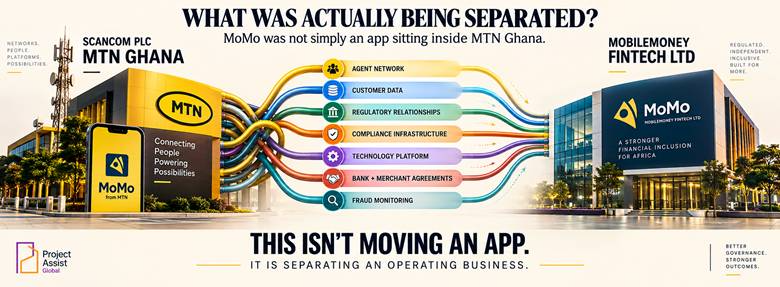
Answering that question, and then building the legal, technical, regulatory, and commercial structure to make the separation real, is what took seven years.
By March 2026, the separated entity held 17.2 million active MoMo users and was generating $549 million in annual revenue.
The local ownership requirement had been met:
The MTN Ghana Fintech Trust, representing Ghanaian minority shareholders, held 28 percent of the new entity.
And in August 2026, five months after the legal separation was completed, Ericsson and MTN Group Fintech announced the completion of a cloud migration that moved MoMo's technology platform from a legacy virtualised environment to a cloud-native architecture.
The results: CPU processing overhead reduced by up to 86 percent, and API response times up to 80 percent faster.
Right?
These events ran in parallel.
A legal separation, a cloud migration, a regulatory compliance programme, and an investor-readiness process:
All running simultaneously, inside one governance structure, and affecting 17 million active users who largely did not notice the transition.
That is not a small thing.
The Programme Nobody Announced
Here is what I noticed in the public coverage of all of this.
The press releases described the new entity, analysts discussed the valuation, and the industry publications covered the technology improvements.
But no one described the governance structure that held seven years of parallel decision-making together.
Who was accountable for the legal separation workstream, the Bank of Ghana compliance workstream, the cloud migration workstream, the agent network transition, and the Mastercard investor-readiness workstream simultaneously?
How did decisions that cut across legal, regulatory, technical, and commercial dimensions get resolved when they conflicted with one another?
Who had the authority to escalate, to pause a workstream, or to prioritise one critical path over another when resources were stretched?
I am not asking these questions rhetorically.
These are exactly the questions I ask when I walk into any complex transformation programme.
Ghana being the first market in MTN Group to complete this separation matters for a specific reason.
It means MTN Ghana was working without an internal precedent.
No playbook existed from a market that had done this before.
That means all governance decisions, regulatory conversations with the Bank of Ghana, and questions about how to structure the Fintech Trust were mostly first-time decisions.
Programme governance matters most when the path is genuinely unclear.
When there is no precedent, the structure that holds decisions together becomes everything.
What Breaks Down at the Workstream Boundaries
Twenty years in this work has shown me that the hardest part of governing a complex transformation is rarely a single workstream failing.
It is decisions that do not get made cleanly across workstream boundaries.
When the legal team says one thing, the technology team says another, and the regulator is waiting on clarity from both, the question becomes:
Who holds that decision?
Who owns the resolution?
Who sits above both workstreams with the authority to say, "This is how we proceed"?
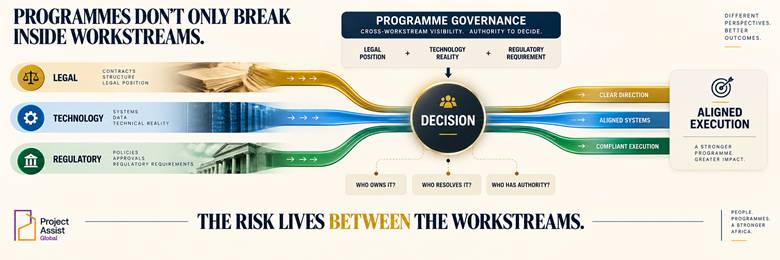
In programmes of this scale, that clarity of ownership is not automatic.
It has to be designed, and it has to be designed before the conflict arrives, not during it.
The executive accountable at the board level needs to know, at every stage, whether the structure producing her programme updates is capable of surfacing what she actually needs to make real decisions.
A clean programme report and the truth of what is happening inside the programme can be two different things.
I have sat across from board members who had received eighteen months of clean monthly updates from a transformation programme, and who were genuinely surprised when I showed them what the programme team already knew about the risks that had not made it into those reports.
That surprise was not unusual.
The structure had not been built to carry that kind of information upward.
And once a programme is in motion, the cost of rebuilding that structure climbs with every month that passes.
MTN Ghana got the outcome right.
The 17 million users transitioned with the cloud migration completed.
The legal entity exists and is operating.
But the governance decisions that made that possible were made years before any announcement.
They were made in the years when there was nothing to announce.
One Question Before Your Next Complex Programme
MTN Ghana's MoMo separation is a remarkable piece of work.
But the next time a programme of comparable complexity lands in front of your board, before you approve the programme plan, I want you to ask yourself one question.
Can you trace the route that an uncomfortable truth would take, from the person who sees it to the person who needs to act on it?
Can you name that route?
Can you test it?
If the answer is yes, your governance structure is probably doing what it needs to do.
If you are not sure, that is worth examining before the programme runs for seven years.
That is exactly what the Programme Health Audit is built to surface.
It contains 24 questions across six dimensions, designed to test whether the governance around your programme is actually doing what leadership assumes it is doing.
It takes about 20 minutes to complete, and it is free.
If your score comes back below 48 out of 96, that is the point at which I want a proper conversation about your delivery governance, before the programme does the talking for you.
Find the Programme Health Audit in my Featured section on LinkedIn or DM me for your copy.
Dr. Anita Appiah
Programme Health Specialist
Founder, PAGL