THE PROGRAMME READ · Governance & decisions
FirstBank Changed Its CEO on Wednesday. By Thursday, the CBN Had Removed Both Boards.
By Anita Appiah ·
Republished from Anita’s original LinkedIn edition. The article retains its original wording and publication context. The current Programme Health Audit takes 10–15 minutes.
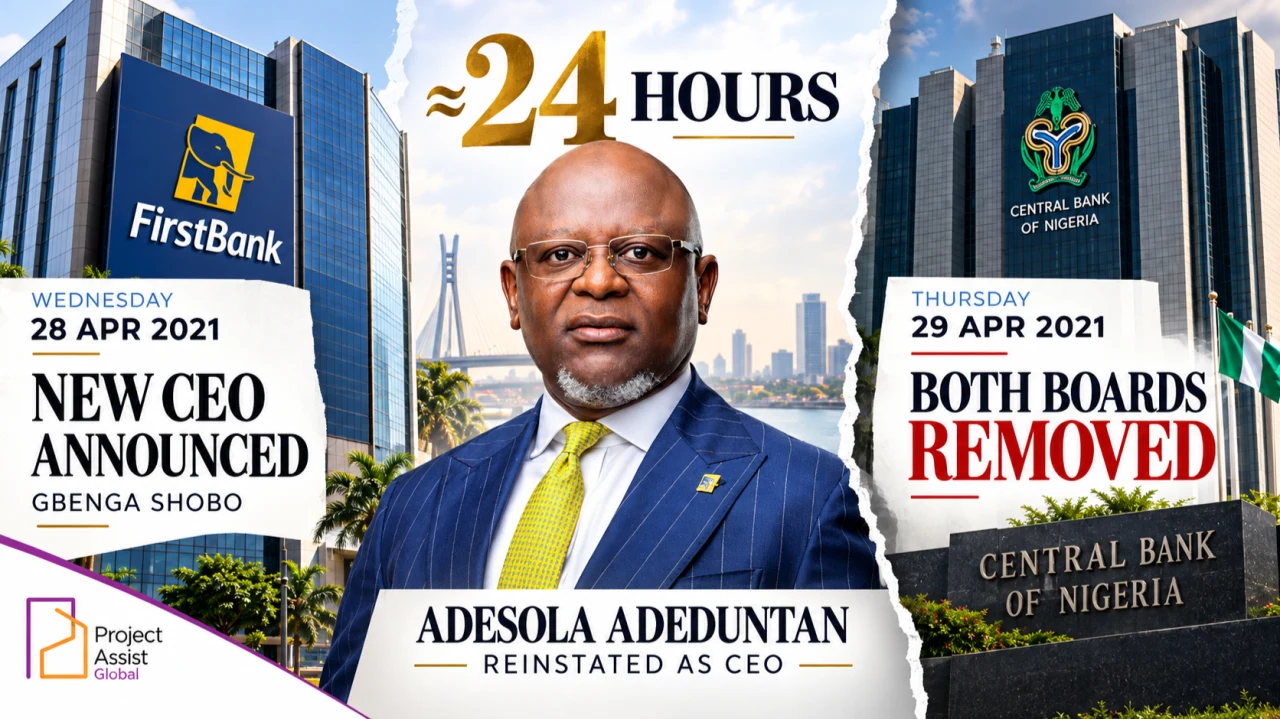
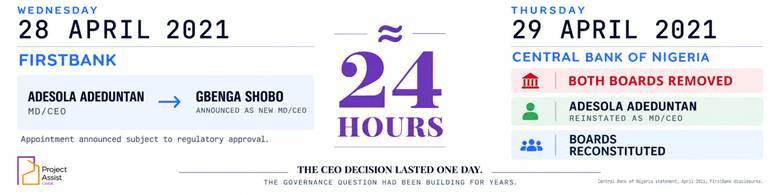
On Wednesday, 28 April 2021, FirstBank announced a leadership change.
Deputy Managing Director Gbenga Shobo would become Managing Director/CEO, replacing Adesola Adeduntan, who had led the bank since 2016.
It looked, publicly at least, like a succession decision.
But the appointment was announced subject to regulatory approval.
Within roughly 24 hours, the situation had changed completely.
Nigeria's central bank did not simply reject the appointment.
The Central Bank of Nigeria removed the directors of First Bank of Nigeria Ltd and FBN Holdings Plc, reconstituted both boards, and reinstated Adeduntan as MD/CEO.
FirstBank subsequently confirmed that he had returned to work.
A board announces a new CEO on Wednesday.
On Thursday, the regulator removes both boards and reinstates the previous CEO.
The question is obvious:
What had to be happening inside the institution for a regulator to respond that quickly to what appeared to be an internal leadership decision?
That is where the story becomes much more interesting.
Why One CEO Decision Became a Financial-Stability Issue
FirstBank was not an ordinary institution in the Nigerian financial system.
At the time, the CBN described it as systemically important.
According to the regulator, the bank had:
more than 31 million customers ₦4.2 trillion in deposits ₦618 billion in shareholders' funds approximately 22% of Nigeria's NIBSS instant-payment processing capacity
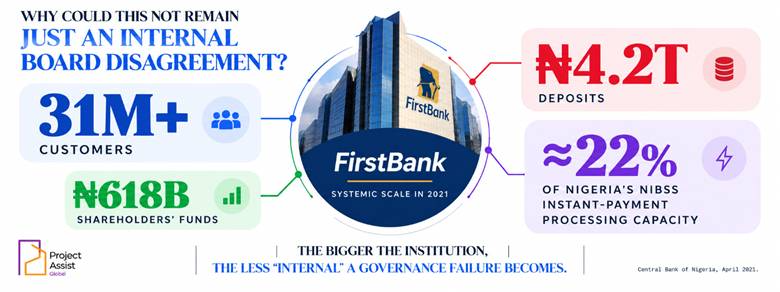
That scale changes the consequence of a governance problem.
A governance failure inside an institution holding trillions of naira in customer deposits is a different category of risk from a disagreement inside a smaller organisation.
Customers, shareholders, and other financial institutions are all connected to the outcome.
And the regulator has to consider what happens if confidence in the institution begins to move faster than management can contain it.
Right?
So, the more useful question is what happened before the regulator reached the point where removing the board looked like the safer option.
The Story Had Started Five Years Earlier
The CBN's own account takes us back to 2016.
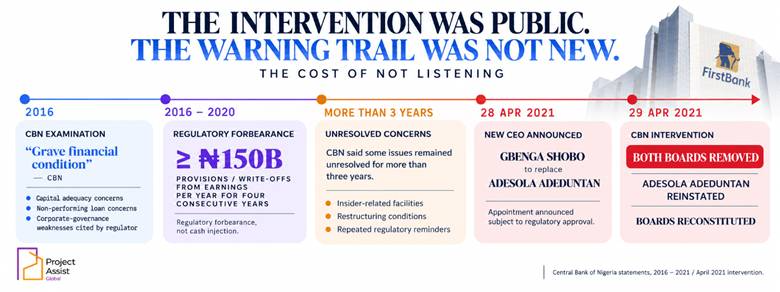
According to the regulator, an examination that year found FirstBank in what it described as a "grave financial condition."
The CBN said the bank's capital adequacy and non-performing loan position had moved outside acceptable prudential standards.
It attributed the deterioration to issues including poor credit decisions, significant non-performing insider facilities, and weaknesses in corporate governance.
That matters because now the April 2021 intervention stops looking sudden.
The regulator said it subsequently provided FirstBank with regulatory forbearance between 2016 and 2020 while the institution worked through its problems.
It also allowed provisions for write-offs of at least ₦150 billion from earnings for four consecutive years as the bank dealt with non-performing exposures.
This should not be confused with a ₦600 billion cash bailout.
That is not what happened.
What matters for this discussion is the duration.
Years, not days.
When The Numbers Improve But The Governance Question Remains
In late 2020, the CBN said FirstBank's broader financial indicators had improved.
But some of the concerns had not disappeared.
The regulator said insider-related facilities remained problematic and that certain issues involving borrowers with influence over the board had remained unresolved for more than three years despite regulatory reminders.
That detail matters.
Because large organisations rarely fail without signals, and the signals are often there.
A risk remains unresolved, a decision is deferred, and the regulator asks again.
Everybody becomes accustomed to the problem being present.
Then one day something happens publicly and everyone calls it a crisis.
But sometimes the crisis is the first moment the outside world can see what the organisation has been living with internally for years.
That is what I call The Cost of Not Listening.
Then Came The CEO Decision
On 28 April 2021, FirstBank announced that Gbenga Shobo would replace Adesola Adeduntan as MD/CEO.
The CBN objected.
According to the regulator, Adeduntan still had approximately eight months remaining on his tenure.
The CBN also said it had received no report alleging misconduct against him and had not been properly consulted before the leadership change was announced.
Against the five-year background, that decision appears very different.
The regulator was not looking only at a CEO appointment.
It was looking at an institution it had already been monitoring, supporting and engaging over an extended period.
And then the board made a significant leadership decision concerning the executive the regulator had been working with through that recovery period.
The following day, the regulator intervened.
Both boards were removed, and Adeduntan was reinstated.
Now, the governance problem had become public.
When Governance Becomes External
There is a point organisations can reach where the most consequential decisions are no longer being driven entirely from inside.
A regulator steps in, a lender sets conditions, and a major shareholder forces a change.
Or a board discovers that somebody outside the programme now has greater confidence in the facts than the people responsible for reporting them internally.
That is an uncomfortable place to arrive.
The organisation has not shed its governance.
The executives, reports, and committees are all still in place.
The problem is that somebody outside the organisation has concluded those structures are no longer adequate to resolve what is happening.
To my mind, that is the most important lesson in the FirstBank story.
And by the time a regulator has to step inside your governance structure and make the decision your board was supposed to own, the failure did not begin that morning.
The public intervention is the end of a chain.
But the more important work is finding the beginning.
What This Has To Do With Your Programme
Most executives reading this will never run a bank with 31 million customers.
But the mechanism is familiar.
A transformation programme has had the same amber workstream for four months.
The risk has appeared at three steering committees.
Everyone agrees something should be done.
The deadline moves, another report arrives, and nothing looks catastrophic.
Until suddenly it does.
Ageing problems change character.
An unresolved issue eventually crosses from delivery risk into a governance question:
Who knew?
When did they know?
And why was the organisation still discussing it months later?
Those questions tell me much more about programme health than the colour on the dashboard.
The Question Worth Asking
If an external regulator, board member, client, or independent reviewer looked at your programme tomorrow, would they see the same picture your executive team is seeing today?
If the answer is yes, good.
If you are not certain, the uncertainty itself is worth investigating.
Because sometimes the most expensive governance problem is information that was available for months and never converted into a decision.
What The Programme Health Audit Tests
This is one of the reasons I built the Programme Health Audit.
Most complex programmes already have dashboards, steering committees, risk registers and reporting structures.
The Audit looks at whether those structures are actually working when the programme is under pressure.
It examines six dimensions of programme health across 24 questions, including reporting integrity, governance and decision quality, stakeholder alignment, delivery integration, risk and dependency control, and benefits clarity.
Because the question underneath all of them is the same:
Can the structure surface a problem while leadership still has time to act?
If you want to test what your own programme governance can actually see, reply "Audit" and I will send you a copy.
Talk soon,
Dr. Anita Appiah
Programme Health Specialist
Founder, Project Assist Global Limited