THE PROGRAMME READ · Independent assurance
The Bank of Ghana Did Not Create Ghana's Banking Crisis. The Clean-up Made It Visible.
By Anita Appiah ·
Republished from Anita’s original LinkedIn edition. The article retains its original wording and publication context. The current Programme Health Audit takes 10–15 minutes.
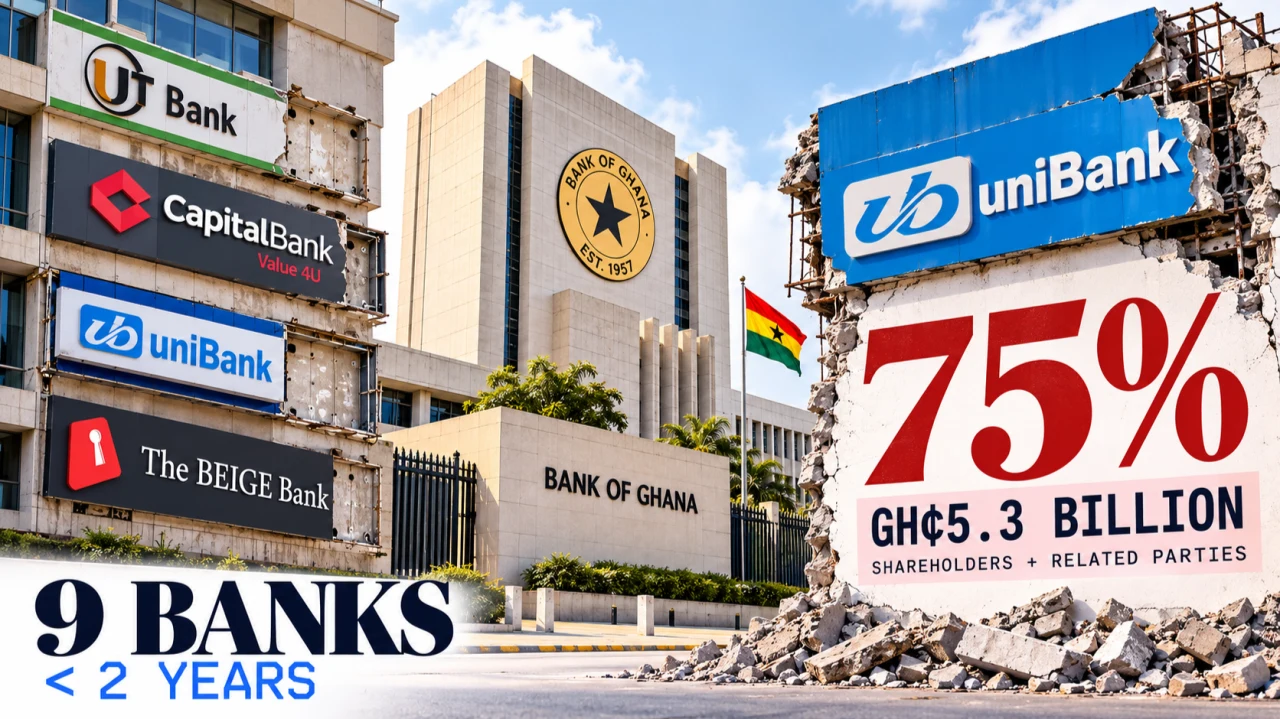
Between August 2017 and the end of 2019, the Bank of Ghana revoked the licences of nine commercial banks operating in Ghana.
Two went in August 2017 (UT Bank and Capital Bank), and their deposits were transferred to GCB Bank.
Five more were merged in August 2018 to create Consolidated Bank Ghana:
uniBank, the Beige Bank, the Royal Bank, Construction Bank, and Sovereign Bank.
In late 2019, the government's estimated fiscal intervention across the wider financial-sector clean-up had reached GHS 16.4 billion, excluding interest payments.
Direct job losses exceeded 6,000.
Thousands more were affected across the wider supply chain, and the coverage at the time focused on the regulator.
Whether the clean-up was necessary, politically motivated, or done too fast.
Those are valid questions, but they are not the question I want to answer.
My questions are simpler.
Who was sitting in those boardrooms?
What were they being told?
And why did the structure that was supposed to catch the problem become the structure that buried it?
What Boards Are Actually For
A board of directors has one job above all others.
It sits above the executive team, reviews the numbers independently of the people who produced them, and ensures that the information reaching decision-makers is accurate.
That is its only irreplaceable function.
Not strategy, not relationships, and not ceremonial oversight.
But independent verification of what is true.
Across the banks that failed, this function was repeatedly absent, compromised, or ineffective.
KPMG's review of uniBank found serious corporate governance, risk management, compliance, and management failures.
But one number tells you the scale of the problem.
According to the Bank of Ghana, shareholders and related parties had taken out GHS 5.3 billion.
That was 75 percent of the bank's total assets.
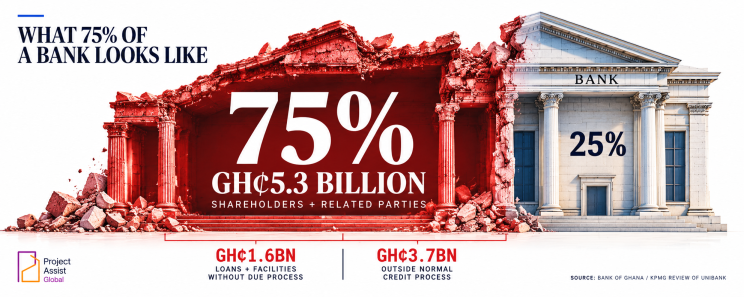
GHS 1.6 billion had been advanced as loans and other facilities without due process.
Another GHS 3.7 billion had not gone through the normal credit delivery process.
And it had not been reported as part of the bank's loan portfolio.
Right?
The board was reviewing reports produced by executives whose loans the board had approved.
The credit committee could not safely say no to the shareholders above them.
The risk function was measuring risks on a portfolio that had already been committed.
The bad loans were a symptom, but the governance failure was the disease.
UT Bank Was Not a Sudden Collapse
UT Bank was one of the most recognisable financial brands in Ghana.
It had grown from a small leasing company into a full commercial bank, with the customer base and the profile to match.
When the Bank of Ghana revoked its licence in August 2017, the stated reason was severe impairment of capital.
You see, capital does not become severely impaired overnight.
The deterioration happens across transactions, decisions, and reporting periods.
And the information sits somewhere before the consequence becomes public.
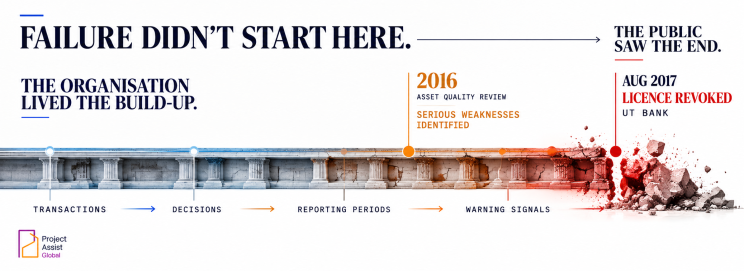
The Bank of Ghana's 2016 Asset Quality Review had already identified serious weaknesses across parts of the banking sector.
In August 2017, UT Bank's licence was gone.
And that distinction matters.
When a bank fails publicly, the story usually starts the day everyone could see it.
But I tend to start earlier.
I want to know when somebody inside the organisation could first see that something was wrong.
And what happened to that information next?
What a Functioning Governance Structure Looks Like
I have spent twenty years working inside organisations where complex transformations were being run.
At Lloyds Banking Group, I was Programme Management Office Manager on a £500 million, two-year banking integration with twenty-three major workstreams.
At BT Global Services, I was Programme Control Manager on a multi-billion, ten-year healthcare business transformation.
In those environments, the governance structure existed to do one thing:
Make sure the people with authority had the right information before the decisions became crises.
That meant something specific.
The people preparing the data were not the same people being evaluated on it.
The risks in the register were the actual risks, not the comfortable version.
And when someone needed to escalate, there was a real path to do it.
A well-functioning governance system for a bank does not look fundamentally different from the governance structure of a large programme.
The review must be independent, and the person who acts on it must have real authority.
In Ghana's banking crisis, what failed was independence at every level.
The boards were connected to the shareholders they were supposed to oversee.
The credit committees could not challenge the executives above them.
And the reporting showed what those in power wanted to see, not what was actually happening.
Every layer built to provide independence had been compromised.
Each one connected, directly or indirectly, to the problem it was meant to detect.
The Cost of Not Listening—When the Structure Makes It Easier to Stay Quiet
To my mind, the most important lesson from the 2017 to 2019 clean-up is not that governance matters.
At this point everyone knows that, but the more specific lesson is this.
Governance structures do not fail because the wrong rules are written.
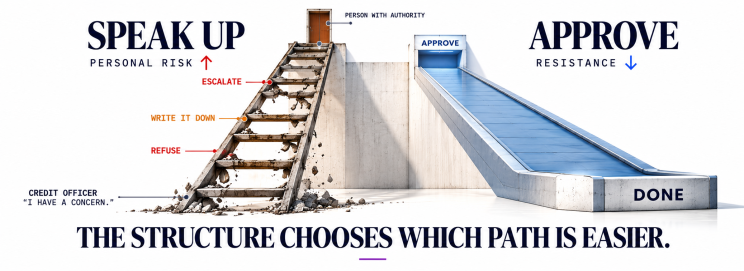
They fail because the structure makes it easier to stay quiet than to speak up.
Picture a credit officer at a bank.
A major shareholder wants a loan approved.
Now, there is a reason the officer approves it.
The credit officer is not necessarily dishonest, but the structure makes refusal the harder choice.
Refusing, escalating, and putting a written objection in the file:
Each carries personal risk, but approving the loan does not.
The Bank of Ghana's Asset Quality Review in 2016 found serious problems before the clean-up began.
Yet the problems persisted.
The information was available.
What was missing was a structure that forced anyone to act on it.
That is exactly what I look for in the Programme Health Audit.
I'm checking whether the structure that produces them can surface what is actually happening, not whether the reports look clean.
What This Has to Do With Your Organisation
You see, I know you might not run a bank and might be thinking:
“Anita, I run a private company. I do not have a board like this. I do not have credit committees. What does any of this have to do with my programme?”
Let me explain.
Every organisation that runs complex programmes has a version of this structure.
The executive who approves the budget usually receives the progress updates too.
The person reading the monthly report also evaluates the project manager who wrote it.
The risk register is updated by the same team whose work is being assessed.
Those are not small things.
These are the conditions under which bad news stays hidden.
It does not reach the person who needs to act on it.
Consider this example.
A CEO hires a programme director to run a technology transformation. The programme director reports directly to the CEO. Every month, the dashboard shows green. The CEO has no independent view of what is actually happening. Six months later, the implementation fails. The CEO is the last person to find out the programme was in trouble.
Or this one.
A credit committee approves a significant loan. The company is owned by a relative of the executive chairing the committee. The loan goes into arrears. The credit officer who flagged concerns has since been moved to a different role. There is no record in the file of the original objection. The regulator finds it three years later.
In both examples, the problem was not hidden.
It was visible to people who were in no position to escalate it.
That distinction matters.
The Question Nobody Wants to Answer
The Bank of Ghana did not create this crisis by cleaning it up.
The crisis existed before 2017, but the clean-up made it visible.
That is the uncomfortable thing about governance failures.
They do not begin when the regulator arrives.
They begin when the first person with a concern decides not to write it down.
Or puts it in writing, and nobody acts.
Or acts and is told to undo what they did.
No one running those nine banks set out to destroy them.
They were run by structures that made it progressively easier to look the other way.
Every organisation has a threshold below which bad news disappears.
The question is not whether yours has one.
The questions are:
Where is your threshold?
And how far past it are you already?
What the Programme Health Audit Tests
The Programme Health Audit exists because the answer to that question is not always obvious from the inside.
It examines six dimensions of programme governance.
The question underneath each one is the same:
Could this structure surface a problem before it became a crisis?
A score below 48 out of 96 indicates a governance problem, not just a delivery problem.
Most organisations that come to me do not believe they have a governance problem.
They have dashboards, steering committee minutes, and risk registers.
Meaning, they have the documents that make governance look present.
But the presence of governance is not evidence that governance is working.
If you would like to find out where your programme governance actually sits, the audit takes 24 questions and 20 minutes.
Reply "Audit" in the comments, and I will send it over.
Talk soon,
Dr. Anita Appiah
Programme Health Specialist
Founder, Project Assist Global Limited
P.S. Consolidated Bank Ghana emerged from the merger of the five failed banks in August 2018. It is still operating today. As of its most recent published results, it has returned to profitability. The regulator did what the boards should have done years earlier. It took the information that was already available and acted on it.