THE PROGRAMME READ · M&A integration
The Governance of Ambition: Access Bank's Pan-African Expansion
By Anita Appiah ·

Republished from Anita’s original LinkedIn edition. The article retains its original wording and publication context. The current Programme Health Audit takes 10–15 minutes.
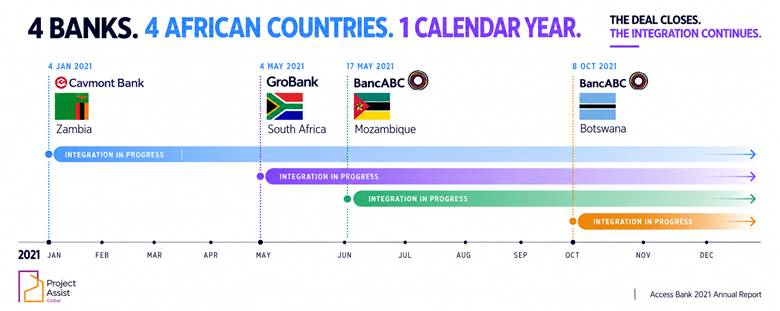
In 2021, Access Bank completed four bank acquisitions across four African countries.
Cavmont Bank in Zambia on 4 January.
GroBank in South Africa on 4 May.
BancABC Mozambique on 17 May.
BancABC Botswana on 8 October.
Four operating banks, four national regulatory environments, four existing workforces, processes, and institutional cultures, all brought into the Access Bank structure in a single calendar year.
That was, above all, an integration challenge.
Because an acquisition does not end when the transaction closes.
That is when the real work begins.
The systems, the reporting lines, the controls, and the people who make them run:
None of that changes because a deal was signed.
And while one newly acquired institution is going through that process, the next deal may already be moving.
That is the part of Access Bank's expansion story I find most interesting.
What "Expansion" Actually Means
In March 2002, Access Bank's board appointed Aigboje Aig-Imoukhuede as Managing Director and Herbert Wigwe as Deputy Managing Director.
Their mandate was specific:
Move Access Bank from 65th position in Nigeria to the Top 10 by 2007.
The bank itself describes that ambition as something many people considered impossible at the time.
Seventeen years later, Access completed its merger with Diamond Bank in March 2019.
That transaction changed the scale of the institution.
Access Bank describes the combined business as one of Africa's largest retail banks by customer base and Nigeria's largest bank by total assets.
Then came the next phase.
In 2021, the organisation was no longer just trying to become one of Nigeria's biggest banks.
It was building a continental footprint.
And that year gives us the clearest picture of what ambition at this scale actually demands.
Right?
It is easy to look at the 2021 list (Zambia, South Africa, Mozambique, Botswana) and see geography.
I look at it and see four integration programmes running simultaneously.
Because each acquisition arrives with an institution that already has employees, customers, technology, policies, reporting structures, controls, and ways of working.
You are not opening four new offices.
You are absorbing four existing organisations while continuing to operate the one you already have.
That is a very different management problem.
The Scale Kept Growing
The numbers after that are worth looking at.
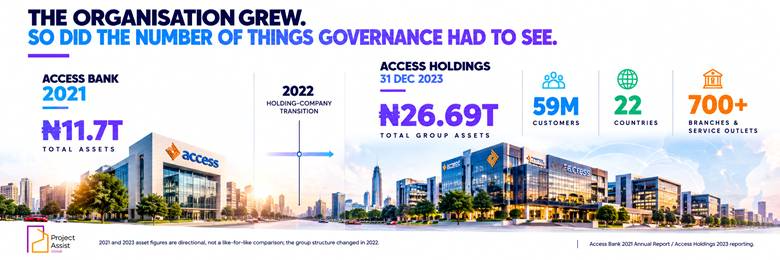
Access Bank reported total assets of approximately N11.7 trillion at the end of 2021.
The organisation then transitioned to a holding-company structure in 2022.
And by 31 December 2023, Access Holdings reported 59 million customers, more than 700 branches and service outlets, operations across 22 countries, and N26.69 trillion in total group assets.
I would not present those two asset figures as a clean comparison, because the corporate structure changed between them.
But the direction is unmistakable.
The organisation was becoming substantially larger and more complex, and complexity changes what governance has to do.
Why This Is a Governance Question
Strategy tells you where you want to go, but it does not integrate the institution you just acquired, reconcile competing reporting lines, decide who owns a cross-border risk, or tell an executive whether last month's health ratings are still accurate.
That is where governance becomes operational.
An oversight structure that works well for one institution can become inadequate when that institution has to absorb several more at once.
As the activity grows, so does the reporting load, the number of regulatory interfaces, and the dependencies between teams.
Executive attention, meanwhile, becomes increasingly scarce.
That does not mean ambitious expansion is a mistake.
It means the oversight architecture has to grow with the ambition.
Access Holdings' own 2023 reporting described strong risk-management practices and an effective monitoring framework.
The organisation ended that year with a non-performing loan ratio of 2.78 percent, below the 5 percent regulatory threshold, and a capital adequacy ratio of 19.01 percent.
Those numbers do not prove that every acquisition was integrated without difficulty or that every reporting line worked exactly as intended, and we should not claim that governance alone produced this outcome.
But they give us something more useful:
An organisation that was reporting rapid expansion and, at the same time, formalising the structures through which risk and performance were supposed to be monitored.
To my mind, that is the governance story:
Governance not as a constraint on ambition, but as part of the infrastructure required to survive it.
The Governance of Ambition
There is a mistake I see organisations make when they become more ambitious.
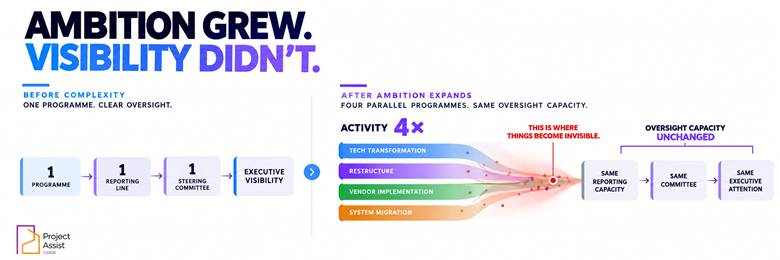
They increase the activity without increasing the organisation's ability to see the activity.
The activity keeps compounding:
New programmes, new vendors, new markets, and acquisitions still integrating while the next one closes.
But the governance structure stays exactly as it was before any of it began.
The executives, the committees, and the risk functions that were built for one scale are now expected to see across a much larger one.
Eventually, something becomes invisible.
There is simply more happening than the existing oversight structure was designed to see.
That is where ambition becomes dangerous.
The information architecture underneath the strategy is too small for what has been built.
On Herbert Wigwe
Any serious account of Access Bank's transformation has to include Herbert Wigwe.
In 2002, he entered Access Bank's senior leadership as Deputy Managing Director alongside Aigboje Aig-Imoukhuede, with the mandate to help transform a bank ranked 65th in Nigeria into a Top 10 institution.
He would go on to become one of the principal architects of the institution Access became.
And he did live to see the scale Access had reached by the end of 2023.
On 9 February 2024, Wigwe died when the helicopter in which he was travelling crashed near Halloran Springs, California.
His wife, his son, and former Nigerian Exchange Group chairman Abimbola Ogunbanjo were also among those killed.
The US National Transportation Safety Board records six fatalities in the crash.
The organisation then had to continue without one of the leaders most closely associated with its transformation.
Roosevelt Ogbonna, who had joined Access Bank in 2002 and been appointed Managing Director and Chief Executive Officer in May 2022, was already in the role.
He was not new to the institution.
That distinction matters.
Continuity after the sudden loss of an important leader does not prove that every governance system is effective.
But it does tell us something about institutional depth.
If the strategy, knowledge, authority, and operating discipline of an organisation exist only inside one person, then that organisation has not really institutionalised them.
It has borrowed them.
What This Has to Do With Your Organisation
You may never acquire four banks in four countries.
But you can still create exactly the same governance problem.
Imagine an organisation running a technology transformation alongside a restructuring programme, a major vendor implementation, and a system migration, all at the same time.
Each one may have a competent team, a credible plan, and positive progress reports.
But somebody still has to see across all four.
Someone independent has to hold the whole picture.
That means seeing across every programme at once, not just into each one individually.
They need to catch when a delay in one programme is about to affect another.
And whether the same people are spread too thin across supposedly separate plans.
The organisation needs an independent view of the whole, and the individual plans alone cannot provide it.
The Question Worth Sitting With
If you are overseeing a significant programme right now, or several at once, ask yourself this:
Are the people preparing the progress reports the same people whose performance is being judged by those reports?
Because if they are, you may have reporting, but you do not necessarily have independent visibility.
And the larger the ambition becomes, the more dangerous that distinction becomes.
Access Bank's story interests me because the expansion did not stop after one acquisition.
The organisation kept adding complexity.
Governance is tested not when everything is stable, but when the ambition gets bigger than the structure that existed before it.
The gap between the pace of the activity and the capacity of the oversight structure to keep up with it is the risk, not the ambition itself.
What the Programme Health Audit Tests
That is one of the reasons I built the Programme Health Audit.
It is not there to check whether your organisation has steering committees, dashboards, or risk registers.
Most large programmes already have those.
The more important question is whether those structures are capable of showing decision-makers what is actually happening while there is still time to act.
The Audit examines six dimensions of programme governance through 24 questions.
The question underneath all of them is the same:
Can this structure surface a problem before it becomes a crisis?
If you want to find out what your own governance structure can actually see, the Audit takes approximately 20 minutes.
Reply "Audit" in the comments and I will send it over.
Talk soon,
Dr. Anita Appiah
Programme Health Specialist
Founder, Project Assist Global Limited
P.S. Herbert Wigwe also founded Wigwe University in Isiokpo, Rivers State, Nigeria. The university officially opened on 17 October 2024, eight months after his death. He did not live to see its doors open.
There is something in that worth remembering. Institutions outlive leaders when enough of the vision has been translated into people, structures, and systems that can keep moving after the person is no longer there.